Last summer, a pizzeria owner named Fekete moved his shop out of Historic Kenwood and into Crescent Heights. Instead of building on-site parking, he started paying nearby businesses to let his customers use their lots. "We can't just survive on people who live in these neighborhoods [and can walk here]," he told a local reporter this spring. It sounds like a small operational decision. It's actually a preview of the same tension now showing up in the neighborhood's home price data.
If you've pulled up Crescent Heights on a portal search, you've probably seen a median price and moved on. But look at two numbers side by side and the story gets more interesting. In June 2026, the average sale price in Crescent Heights came in at $704,000, down 40.9 percent from the same month a year earlier. Over the three months ending in May 2026, the median sale price was up 4.1 percent year over year, landing at $825,000. Same neighborhood. Same general window. Numbers moving in opposite directions.
That's not a typo and it's not a broken dataset. It's what happens when a very small housing market gets measured with tools built for bigger ones.
A Neighborhood That Different Sources Can't Quite Agree On
Part of the reason these numbers wobble is that Crescent Heights is genuinely small, and its edges shift depending on who's drawing the map. Some descriptions place the eastern boundary at 4th Street North, bordering Historic Old Northeast. Others put Old Northeast further east and treat 4th Street as a corridor running through the middle of the neighborhood. The western edge lands somewhere near Dr. Martin Luther King Jr. Street North, bordering Greater Woodlawn, with 22nd Avenue North and 30th Avenue North forming the rough north-south limits.
Population counts for the neighborhood range from roughly 1,500 to nearly 2,700 depending on the source, which is a wide spread for a place this compact. When the geographic footprint isn't standardized, neither is the sales pool feeding into any given price statistic. A dataset built on a few dozen closings a year is going to move around more than one built on thousands. That's not a flaw in Crescent Heights. It's just what a small sample looks like when you zoom in.
Even the days-on-market figures don't fully agree. One tracking source puts the average at 46 days, faster than the national average of 58. Another describes the market as "somewhat competitive," with homes typically going to pending in around 60 days and selling for about 2 percent below list price. Both can be true. They're measuring slightly different things, in a market too thin to smooth out the difference.
What's Actually Closing Escrow
The bigger driver behind the average-versus-median gap isn't measurement noise. It's what's actually selling.
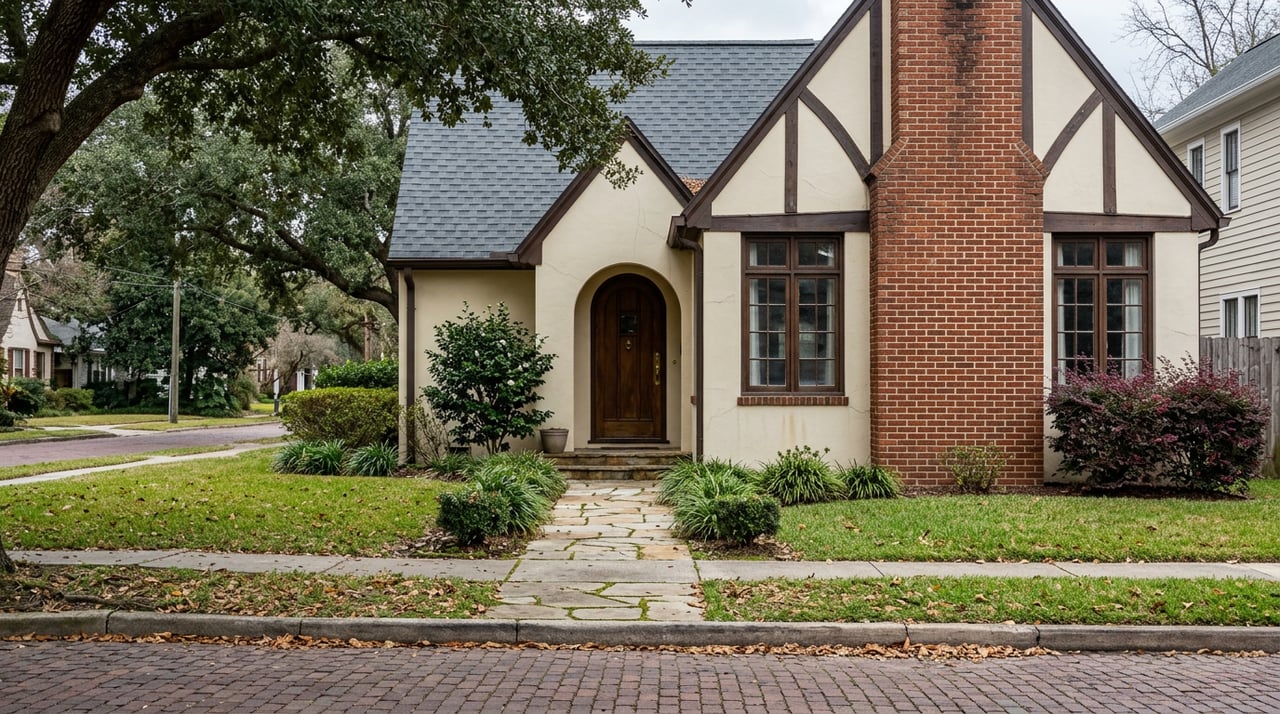
Crescent Heights was built out over roughly forty years starting in the early 1920s, and the housing stock reflects it. Early sections lean Craftsman, Colonial Revival, Mediterranean Revival, and Tudor, with one stretch of 8th Street known for a cluster of 1920s Tudor houses. Later infill along the lake brought Minimal Traditional and Ranch styles from the late 1930s onward. That's the base layer of the market: modest square footage, original lots, character-driven pricing.
Layered on top of that base is a wave of new construction and full-gut rebuilds. Current listings include brand-new builds over 3,000 square feet and at least one documented top-to-bottom reconstruction marketed as new construction on a legacy lot. These properties sell in a different price tier entirely from the surrounding bungalows.
When a market this small closes even one or two of those high-dollar new builds in a given month, the average gets pulled hard in one direction. The median holds steadier because it's anchored by the more typical bungalow resale in the middle of the distribution. That's the mechanism behind the 40.9 percent average decline sitting next to a 4.1 percent median gain. It's not that values are falling. It's that the mix of what happened to close in any given window shifted, and the average is far more sensitive to that shift than the median is.
The practical takeaway: if you're comparing Crescent Heights to another St. Pete neighborhood using a single headline price, you're not comparing like inventory. You're comparing whatever happened to sell that month, in a market small enough that one unusual transaction can swing the average by tens of thousands of dollars.
Why The Parking Story Matters To Buyers, Not Just Diners
Which brings the story back to Fekete's pizzeria. The parking arrangement he described isn't an isolated business decision. It's connected to a zoning change the city made this year.
In May 2026, St. Petersburg City Council approved the SunRunner Bus Rapid Transit Overlay, eliminating minimum parking requirements for new development along much of the Central Avenue corridor and nearby streets served by the bus line. The goal, according to reporting from the St. Pete Catalyst, was to lower development costs and encourage denser, more walkable growth near transit. The tradeoff, according to the same reporting, is that critics worried the change could push overflow parking into surrounding residential streets.
Crescent Heights was one of the neighborhoods named directly in that debate. Along with Allendale Terrace and Magnolia Heights, residents along the 4th Street North and Dr. Martin Luther King Jr. Street North corridors raised concerns as commercial activity expanded into those edges, according to a June 2026 report from St. Pete Rising covering a follow-up City Council discussion on resident parking zones. That same reporting is where Fekete's comment about relying on customers who can walk in comes from.
None of this means the neighborhood has a parking problem today. It means the commercial edges of Crescent Heights, the same 4th Street and MLK corridor stretch that gives residents walkable access to restaurants and shops, are absorbing growth that the city's own zoning change was designed to encourage. If you're evaluating a home near that edge, it's worth understanding that the neighborhood's walkability and its commercial growth are pulling in the same direction, and asking a seller or agent how parking has played out on that specific block rather than assuming it mirrors the interior streets closer to Crescent Lake.
What This Means If You're Comparing Crescent Heights To Somewhere Else
Put these pieces together and the picture is less about whether Crescent Heights is appreciating or cooling and more about which Crescent Heights you're actually shopping in.
If you're looking at original-condition bungalows on the interior streets, the median figures, hovering around $825,000 with fairly consistent modest growth, are a reasonable anchor. If you're looking at new construction or a documented full rebuild, expect a meaningfully higher price point that the median doesn't capture well, since those sales are still a small share of total volume. And if the home you're considering sits near the 4th Street or MLK corridor, factor in that the commercial character of that edge is actively changing under a city policy that's less than four months old as of this writing.
The honest read on Crescent Heights right now isn't a single number. It's a market where the headline stats disagree with each other for identifiable reasons, and where understanding those reasons tells you more about what you'll actually pay than the median alone ever will.
A Few Quick Questions
Is Crescent Heights a buyer's market or a seller's market right now? The data doesn't point cleanly in either direction. One tracking source rates it "somewhat competitive" with homes selling slightly below list price, which suggests a fairly balanced market rather than one strongly favoring either side.
Why do different sites report different home counts or boundaries for Crescent Heights? The neighborhood doesn't have a single, universally agreed boundary. Different sources place the eastern and western edges on different streets, which changes which sales get counted in any given dataset.
Does the SunRunner overlay affect all of Crescent Heights or just the commercial edges? The parking minimum elimination applies specifically to properties along the Central Avenue corridor and within a set distance of SunRunner stations. The concerns raised by Crescent Heights residents centered on the 4th Street North and MLK Jr. Street North corridors, not the neighborhood's interior blocks.
If you're weighing a move into Crescent Heights, or trying to figure out how its numbers stack up against another St. Pete neighborhood on your list, that's exactly the kind of block-by-block context worth working through before you make an offer. Silver and Welch Collective can walk you through what's actually selling on the street you're considering, not just the headline stat. Schedule a free consultation.